


Back to College: Forecasting for spare parts management
Better forecasts, better inventory decisions
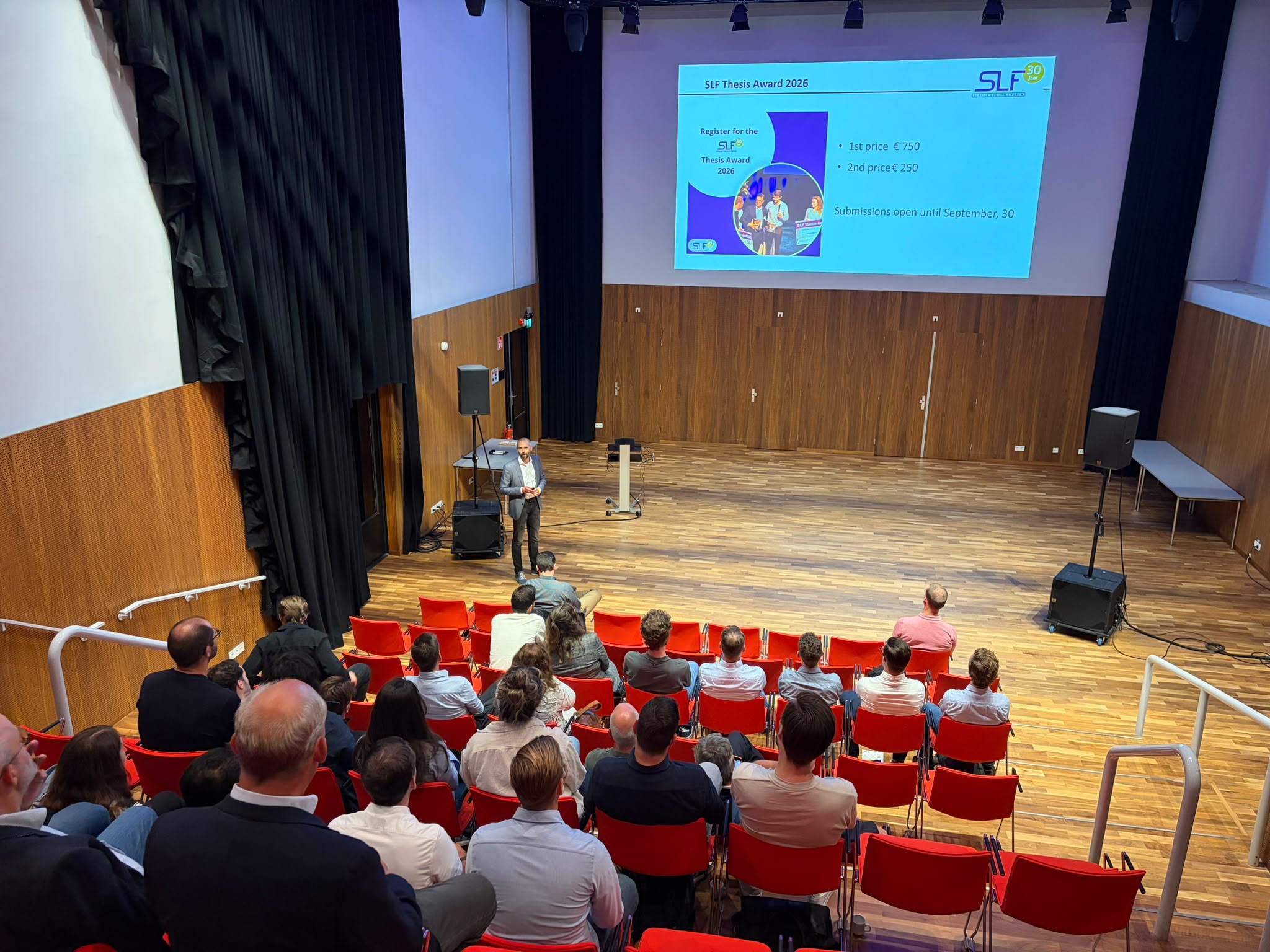
For the third year in a row, SLF organized its Back to College event. Hosted by TU Eindhoven, the afternoon brought together theory and practice around a topic that remains highly relevant in service logistics: forecasting spare parts demand.
The theory behind forecasting for spare parts management
The event kicked off with a presentation by Prof. Ruud Teunter of the Rijksuniversiteit Groningen. Drawing on a strong theoretical foundation, he explained why forecasting demand for spare parts differs fundamentally from forecasting faster-moving products. Since spare parts often experience long periods with zero demand, traditional forecasting methods such as moving averages or single exponential smoothing are often not suitable. Through clear examples, he demonstrated why methods such as Croston's method and the TSB method are better equipped to handle intermittent demand patterns. Ruud also addressed questions around forecast aggregation levels and the choice of forecasting periods. An important takeaway was that a forecast should not be evaluated in isolation, but on its ability to support effective inventory decisions. In other words: a forecast is only valuable if it contributes to better inventory performance.
Forecasting from a practical perspective
After the break, Rogier Zoun of Gordian Logistic Experts continued the discussion from a practical perspective. He confirmed many of the insights presented earlier and shared how forecasting is applied within real-world spare parts environments. While different forecasting methods may be appropriate across an assortment, particularly for faster-moving parts, he also advocated the use of Croston-type methods for slow movers. For extremely slow-moving items, Rogier suggested that a formal forecasting method may not always be necessary, a viewpoint that sparked an interesting discussion with Ruud.
The presentations generated plenty of questions from the audience, resulting in a lively and interactive exchange of ideas. The discussion continued during the networking drinks afterwards, giving participants the opportunity to further explore the topic and connect with fellow professionals.
Once again, the Back to College event proved to be a valuable combination of academic insight, practical experience and networking, exactly what the SLF community stands for.




![DHL Supply Chain [Netherlands] BV](https://www.servicelogisticsforum.nl/storage/cache/images/579203eb4b327_dhl-1--1-w250-h125.jpg)


